.

Friday, June 10, 2011

Emerging Market Currencies Still Look Good for the Long-Term

Emerging Market Currencies Still Look Good for the Long-Term
In my previous update on emerging market currencies, I wrote that in the short-term, it’s important not to lump them all together; high-yielding currencies must be distinguished from low-yielding ones. In this post, I’m going to backpedal a bit and argue that over the medium-term and long-term, emerging market currencies as an asset class are still a good bet.
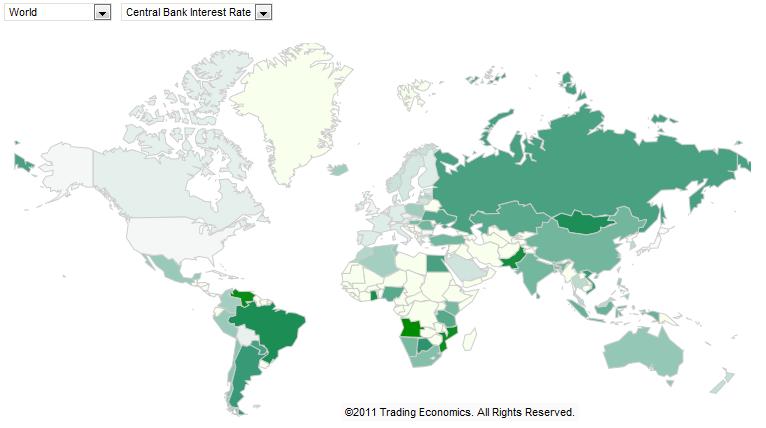
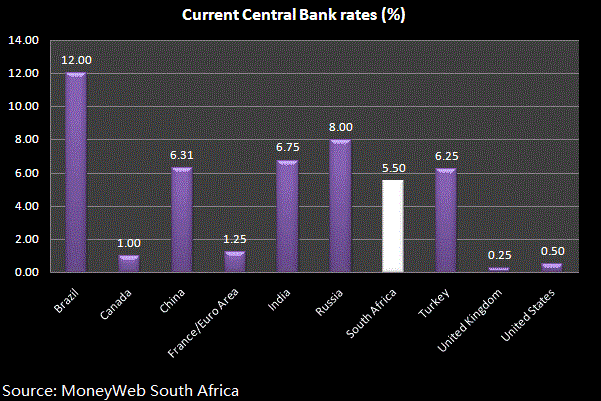
Most emerging market central banks have already begun to tighten monetary policy in order to mitigate against runaway inflation, overheating economies, and asset bubbles. You can see from the chart above (where a dark shade of green signifies a higher benchmark interest rate) that the overwhelming majority of high-yielding currencies belong to emerging market economies. (In fact, if not for Australia, it would be possible to say all high-yielding currencies).
While industrialized central banks are also expected to begin tightening, the timetable is much less certain, due to slowing growth, high unemployment, and low inflation. If current trends continue, then, interest rate differentials should only widen further between industrialized currencies and emerging currencies. Without taking risk into account, the most profitable carry trade will involve shorting the lowest-yielding currency against the highest-yielding currency(s). Alas, liquidity must also be taken in account, and the Angolan Kwanza – with an interest rate of 20% – is probably not a viable candidate. As one fund manager summarized, “[If] we feel like it’s a country where if we exit we are sort of going to shoot ourselves in the foot [due to lack of liquidity], then we won’t go in the first place.
Over the long-term, meanwhile, emerging market currencies will receive a boost from two related forces: strong fundamentals and capital inflows. With regard to the former, emerging market economies already account for the lion’s share of global GDP growth. The World Bank projects that over the next 15 years, emerging market economies will collectively expand by 4.7%, compared to 2.3% in the developed world. As a result of this strong growth, combined with fiscal prudence, debt levels across the developing world are generally falling. It marks a significant reversal that none of the current sovereign debt crises involves an emerging market country. What is more amazing is that some emerging market economies (Mexico, Russia, and Brazil) that struggled with bankruptcy less than a decade ago now have investment-grade credit ratings!
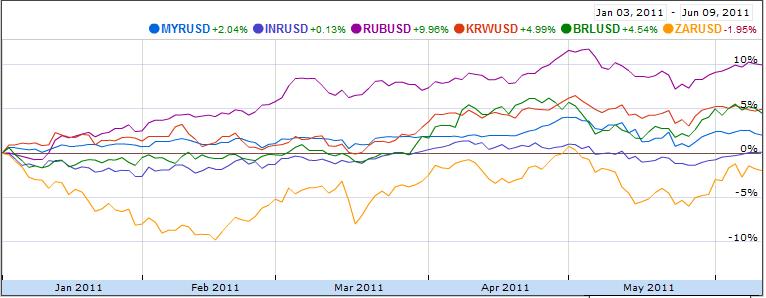
As a result, capital flows into emerging markets should continue to surge. Even though emerging market equity and bond funds have witnessed record inflows over the last few years, portfolio allocations still remain extremely low. For example, “U.S. defined-contribution pension plans only have 2.1% of their funds allocated to developing economies, which make up nearly 50% of global GDP.” Emerging market bonds, meanwhile, account for an estimated 1% of total assets under management. This trend will be further reinforced by domestic investors, which will probably opt to keep more capital in-country.
Of course, the risks are manifold. First of all, there is a risk that these capital inflows will provoke a backlash. “Emerging countries have adopted a broad range of measures to regulate inflows and stem currency rises, increasingly resorting tocapital controls and so-called macro-prudential measures such as credit curbs.” Now that they have the blessing of the IMF, emerging market currencies might conceivably be more audacious in trying to limit currency appreciation. On a related note, there is also the possibility that emerging market central banks will fall behind the curve, perhaps deliberately. Lower-than-expected interest rates and hyperinflation would certainly dent the attractiveness of going long such currencies.
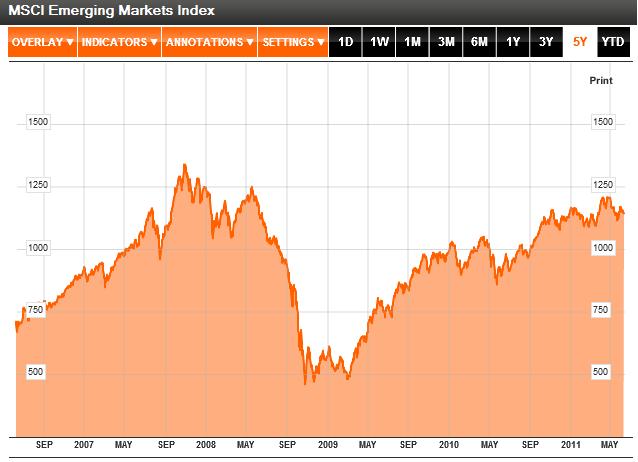
Finally, it is possible that in all of their excitement, investors are bidding up emerging market assets to bubble levels. The Wall Street Journal recently reported, for instance, that commodity prices and emerging market currency returns have become strongly correlated. Given that many of these countries are in fact net importers of energy and raw materials, this shows that emerging market currencies are rising more in proportion to risk appetite than to economic fundamentals. If when this risk appetite ebbs, then, this could send emerging market currencies crashing.

Friday, May 20, 2011

G7 Leads Shift in Forex Reserves

G7 Leads Shift in Forex Reserves
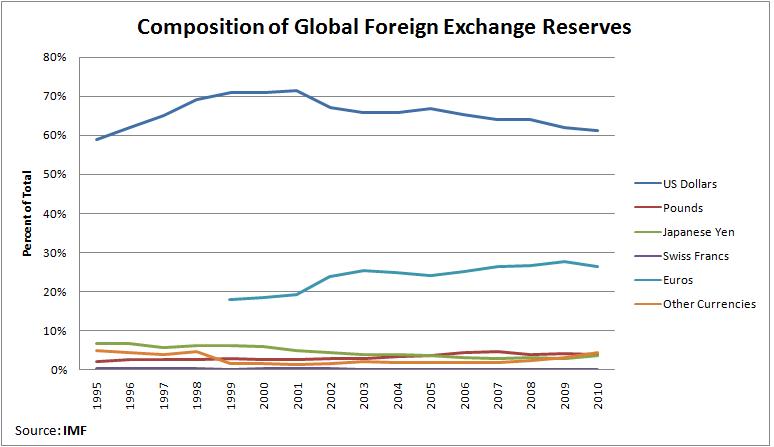
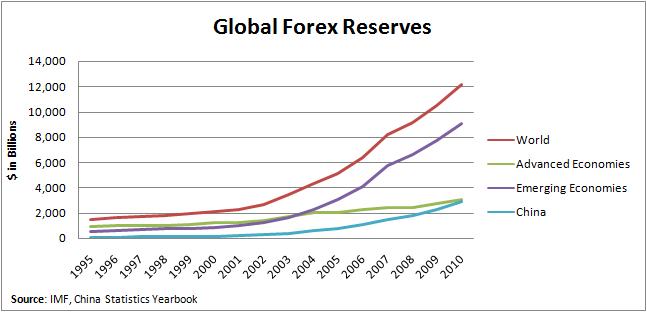
As you can see from the chart below, the world’s foreign exchange reserves (held by central banks) have undergone a veritable explosion over the last decade. While emerging markets (especially China!) have accounted for the majority of this growth, there are indications that this could soon change. China’s reserve accumulation is set to slow, while advanced economies’ reserves are set to increase.


In the past, central banks from advanced economies have accumulated reserves only sparingly, and in fact, much of this growth can be claimed by Japan. This is no mystery. While held by emerging economy central banks, most of the reserves are denominated in advanced economy currencies. This has ensured a plentiful supply of cheap capital, to support both economic expansion and perennial current account deficits (namely in the US!). In addition, advanced economy central bankers tend to hew towards economic orthodoxy, which precludes them from intervening in forex markets, and obviates the need to accumulate forex reserves. Emerging economies, on the other hand, depend principally on exports to drive growth. As a result, many are driven towards holding down their currencies in order to maintain competitiveness. China has taken this to an extreme, by exercising rigid control over the value of the Yuan, and necessitating the accumulation of $3 trillion in foreign exchange reserves.
This trend accelerated in 2010 with the inception of the so-called currency wars(which have not yet abated). Competing primarily with each other, emerging economies bought vast sums of foreign currency in order to promote economic recovery. Many countries from South America and Asia which don’t normally intervene were also drawn in. The result was a tremendous accumulation of foreign exchange reserves, which is reflected in the chart above.
There is already evidence that this phenomenon is starting to reverse itself. Consider first that advanced economies have participated in the currency wars as well. Japan’s reserves have swelled to more than $1.1 Trillion. Switzerland spent $200 Billion defending the Franc, and South Korea has spent more than $300 Billion over the last five years trying to hold down the Won. The Bank of England (BOE) recently announced plans to rebuild its reserves (the majority of which were redeployed towards gilt purchases). The European Central Bank (ECB) has announced similar plans, and may be joined by the Bank of Canada and US Federal Reserve Bank.
Advanced economies need currency reserves for a couple reasons. First of all, they can no longer rely on monetary easing to reduce their exchange rates because of the inflationary side-effects. Second, the recent coordinated intervention on Japan’s behalf showed that the G7 will move to protect its members when need be. Finally, political forces are compelling advanced economies to slow the outflow of jobs and production, and this requires more competitive exchange rates.
Emerging economies, meanwhile, are starting to recognize that unchecked reserve accumulation is neither sustainable nor desirable. First of all, managing those reserves can be tricky. Intervention is not free, and exchange rate and investment losses must be accounted for somewhere. Second, continued intervention has several detrimental byproducts, namely inflation and the handicapping of domestic industry. Finally, emerging economy currency appreciation is inevitable. Constant intervention merely forestalls the inevitable and invites unending speculation and inflows of hot-money.
There are a few of ways that currency investors can position themselves for this change. As emerging market economies stop the accumulation of (or worse, sell off) their reserves, a major source of demand for advanced economy currency will be curtailed. This will accelerate the broad-based appreciation of emerging market currencies against their advanced economy counterparts. At the same time, I’m not sure how much reshuffling we will say in the composition of reserves. The euro is plagued by existential uncertainty, while the yen and pound have serious fiscal problems. In the short-term, the Chinese Yuan is prevented by several factors from becoming a legitimate reserve currency, namely that it is too difficult to obtain. (As soon as this changes, you can bet that emerging economy central banks will begin accumulating it. After all, they are competing with China – not with the US). The dollar is certainly also an “ugly” currency, but given the size of the US economy, the depth of its capital markets, and the liquidity with which the dollar can be traded, it will remain the go-to choice for the immediate future.
In the short-term, traders that wish to short advanced economy currencies (namely the Japanese yen) can do so in the secure knowledge that they are backstopped by the G7 central banks. It’s like you have an automatic put option that limits downside losses. If the Yen falls, you win! If the yen rises, the BOJ & G7 should step in, and at least you won’t lose!

Saturday, May 7, 2011

SA Rand in Bubble Territory

SA Rand in Bubble Territory
The story of the South African Rand (ZAR) is nearly identical to that of other leading emerging market currencies: multi-year gains were completely undone by the 2008 credit crisis, only to be restored in 2009 and 2010. From trough to peak, the Rand has now risen 64%, including 15% over the last twelve months and 10% over the last six weeks. While the reasons for its renewal are understandable, they are far from justifiable. Based on a number of metrics, the Rand now appears to be somewhat overvalued.
 
Just like its BRIC (which it was recently invited to join) peers, the Rand’s appeal lies in high growth prospects and even higher nominal interest rates. It has also been bought amidst the general pickup in risk appetite (complacency) that has spurred investors back into emerging markets. Given the relatively small size of its economy and proportionately small money supply, it’s no surprise that demand for Rand – made worse by the difficulty of betting directly on China - has overwhelmed the supply.
Despite repeated cuts, South Africa’s benchmark interest rate still stands at a lofty 5.5%. Relative price stability also means that interest rates are positive in real terms, a claim which few countries can make nowadays. Thanks to bond yields hovering around 8% and a comparatively modest government debt, lending to South Africa still carries a significant risk-adjusted return advantage over other emerging markets. The Bank of South Africa is trying to hold off on hiking rates for as long as possible, partly to avoid stimulating the Rand. Its decision to tighten will essentially be determined by the battle between unemployment and inflation. With more than 25% of South Africans out of work, the Bank is understandably reluctant to take any steps that would ameliorate that problem.
 
Perhaps above all else, the Rand’s rise has been closely correlated with the ongoing commodities boom. South Africa is the world’s largest producer of platinum and palladium, second largest of gold, and at the top of the rankings for a handful of other precious metals and minerals. Thus, you can see from the chart below that the Rand/Dollar rate has very closely tracked platinum and gold prices for the last twelve months. Aside from a modest correction (induced by a temporary ebb in risk aversion) at the end of 2010, the three assets appear to have moved in lockstep!
 
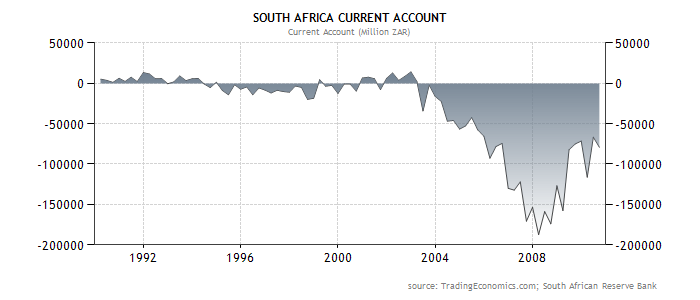
While rising commodities prices have certainly been a boon to South Africa’s foreign exchange reserves, it hasn’t done much for its economy. In fact, mining comprisesonly 3% of South Africa’s economy (down from 14% two decades ago), and analysts expect that this proportion will decline further as deposits are mined to exhaustion. Its balance of trade fluctuates between surplus and deficit, as revenues from increased commodities exports are turned around and spent on imports. (China is now South Africa’s largest trading partner). Still, given the record current account deficits of the last few years, foreign investors evidently are undeterred from bridging the South African shortfall in domestic investment, even (or especially!) at current exchange rates.
 
Going forward, there are plenty of analysts that believe the Rand will continue rising, at a healthy rate of around 10% per year. This notion is based as much on the depreciation of major currencies - which were punished for their respective Central Banks’ expansionary monetary policies - as it is in the appreciation of the Rand. In fact, the Rand’s performance against a basket of emerging market currencies has been more modest; on a trade-weighted basis, it has still risen an estimated 15% since 1995. Regardless, this suggests that any bubble underlying the Rand is no different from that which may affect any number of other currencies.
 
Still, it’s hard to argue with fundamentals. According to one back-of-the-envelope analysis based on purchasing power parity (ppp) differentials, the Rand will need to depreciate significantly if it is to return to more normalized valuation levels. “Since 2000, South African inflation has exceeded that of the US by 44 percent, while the rand has depreciated by just over 10 percent, which means that goods in South Africa are now over 30 percent more expensive for Americans than they were a decade ago… it is impossible to know when this difference will unwind, but…it is reasonable to assume that it will unwind in every five-year period, and this would entail a depreciation in the rand-US dollar exchange rate of six percent a year.”Reasonable indeed.
 
Ultimately, it is going to be tough to sell this argument to carry traders, who care more about interest rate differentials than inflation differentials, which means the Rand could continue to rise over the short-term. Over the medium-term, however, the Bank of South Africa may see to it that this trend does not continue.

Friday, April 29, 2011

Emerging Market Currency Correlations Break Down

Emerging Market Currency Correlations Break Down
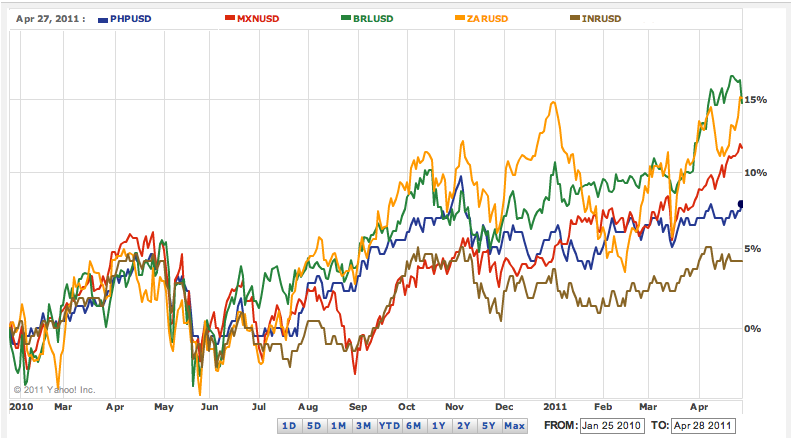
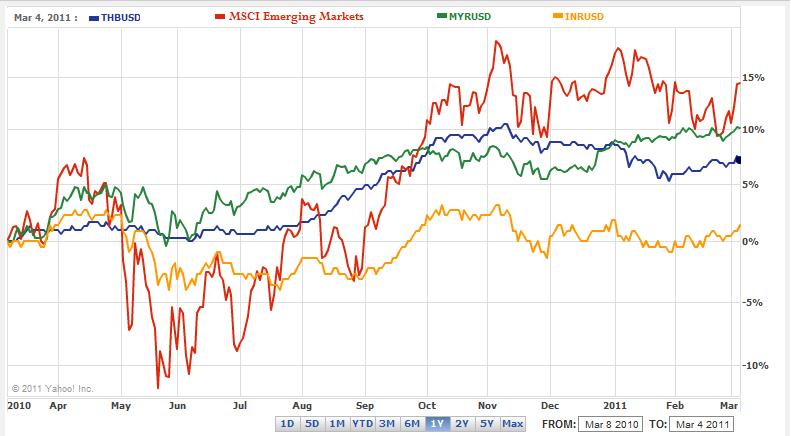
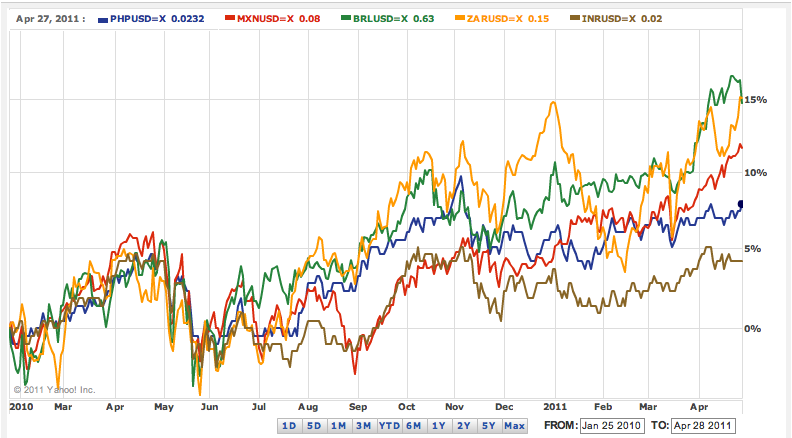
A picture is truly worth a thousand words. [That probably means I should stop writing lengthy blog posts and instead stick to posting charts and other graphics, but that's a different story...] Take a look at the chart below, which shows a handful of emerging market (“EM”) currencies, all paired against the US dollar. At this time last year, you can see that all of the pairs were basically rising and falling in tandem. One year later, the disparity between the best and worst performers is already significant. In this post, I want to offer an explanation as to why this is the case, and what we can expect going forward.

In the immediate wake of the credit crisis, I think that investors were somewhat unwilling to make concentrated bets on specific market sectors and specific assets, as part of a new framework for managing risk. To the extent that they wanted exposure to emerging markets, then, they would achieve this through buying broad-based indexes and baskets of currencies. As a result of this indiscriminate investing, prices for emerging market stocks, bonds, currencies, and other assets all rose simultaneously, which rarely happens.
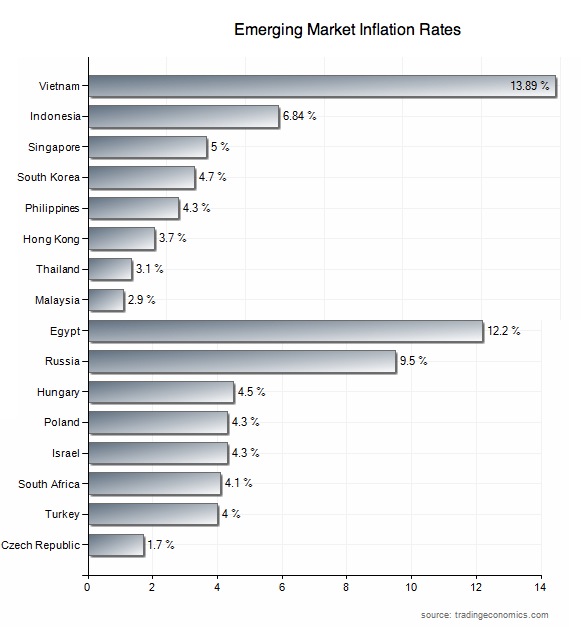
Around November of last year, that started to change. The currency wars were in full swing, inflation was rising, and there were doubts over whether EM central banks would have the stomach to tighten monetary policy, lest it increase the appreciation pressures on their respective currencies. EM stock and bond markets sputtered, and EM currencies dropped across the board. Shortly thereafter, I posted Emerging Market Currencies Still Have Room to Rise, and currencies resumed their upward march. It wasn’t until recently, however, that bond and stock prices followed suit.
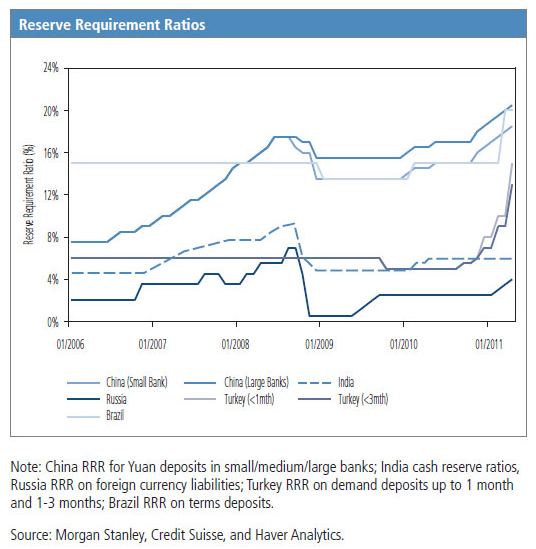
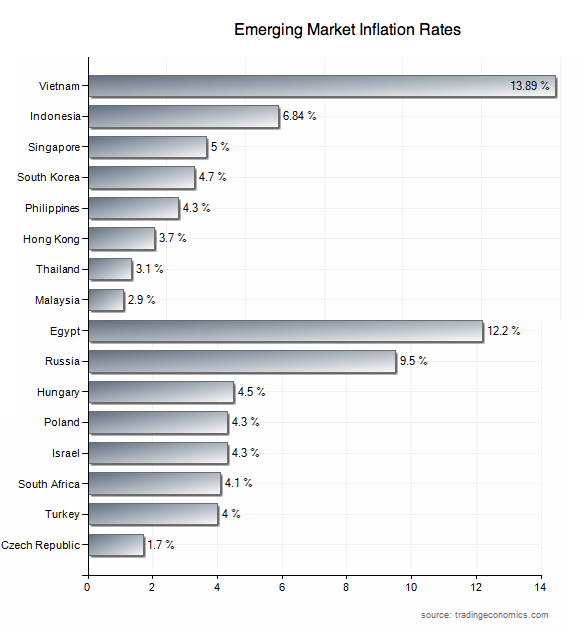
What changed? In a nutshell, emerging market central banks have gotten serious about tackling inflation. That’s not to say that they raised interest rates and accepted currency appreciation as an inevitable byproduct. On the contrary, they have adopted so-called macroprudential measures (quickly becoming one of the buzzwords of 2011!), with the goal of heading off inflation without influencing broader economic growth. Most EM central banks have sought to achieve this by raising their required reserve ratios (see chart above), limiting the amount of money that banks can lend out. In this way, they sought to curtail access to credit and limit growth in the money supply without inviting a flood of yield-seeking investors from abroad. Other central banks have gone ahead and hiked interest rates (namely Brazil), but have used taxes and other types of capital controls to discourage speculators.
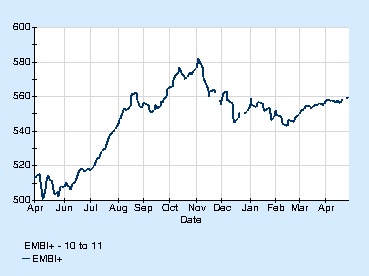
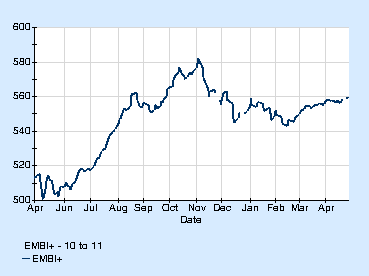
You can see from the chart of the JP Morgan Emerging Market Bond Index (EMBI+) below that EM bond markets have rallied, which is the opposite of what you would normally expect from a tightening of monetary policy. However, since EM central banks have thus far implemented tightening without directly influencing interest rates, bond yields haven’t risen as you might expect. In addition, whereas sovereign credit ratings are falling in the G7 as a result of weak fiscal and economic outlooks,ratings are actually being raised for the developing world. As a result, EM yields are falling, and the EMBI+ spread to US Treasury securities is currently under 3 percentage points.
The primary impetus for buying emerging markets continues to come from interest rate differentials. Given that interest rates remain low (on both an historical and inflation-adjusted basis), however, it’s unclear whether support for EM currencies will remain in place, or is even justified. Furthermore, I wonder if demand isn’t being driven more by dollar weakness than by EM strength. If you re-cast the chart above relative to the euro, the performance of EM currencies is much less impressive, and in some cases, negative. This trend is likely to continue, as Ben Bernanke’s recent press conference confirmed that the Fed isn’t really close to hiking interest rates.
Ultimately, the outlook for EM currencies is tied closely to the outlook for inflation. If raising the required reserve ratios is enough to head off inflation (and other forces,such as rising commodity prices, abate), then EM central banks can probably avoid raising interest rates. In that case, you can probably expect a correction in forex markets, which will be amplified by rate hikes in the G7. On the other hand, if inflation continues to rise, broad EM interest rate hikes will become necessary, and the floodgates will have been opened to carry traders.Either way, the gap between the high-yielding currencies and the low-yielding ones will continue to widen. In answering the question that I posed above, I expect that regardless of what happens, investors will only become more discriminate. EM central banks are diverging in their conduct of monetary policy, and it no longer makes sense to treat all EM currencies as one homogeneous unit.

Saturday, April 23, 2011

Icelandic Kronur: Lessons from a Failed Carry Trade

Icelandic Kronur: Lessons from a Failed Carry Trade
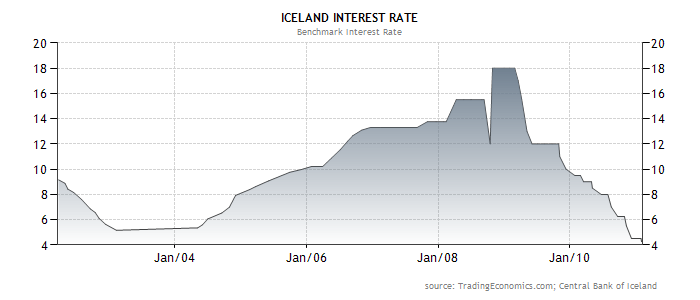
A little more than two years ago, the Icelandic Kronur was one of the hottest currencies in the world. Thanks to a benchmark interest rate of 18%, the Kronur had particular appeal for carry traders, who worried not about the inherent risks of such a strategy. Shortly thereafter, the Kronur (as well as Iceland’s economy and banking sector) came crashing down, and many traders were wiped out. Now that a couple of years have passed, it’s probably worth reflecting on this turn of events.


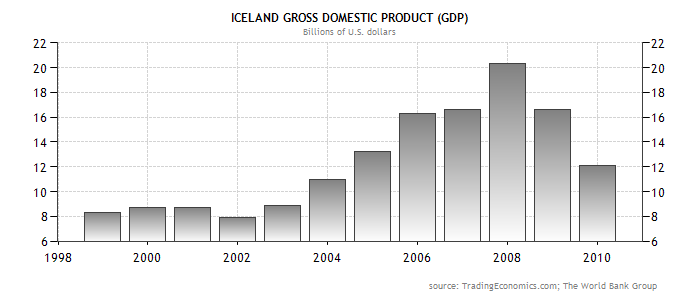
At its peak, nominal GDP was a relatively modest $20 Billion, sandwiched between Nepal and Turkmenistan in the global GDP rankings. Its population is only 300,000, its current account has been mired in persistent deficit, and its Central Bank boasts a mere $8 Billion in foreign exchange reserves. That being the case, why did investors flock to Iceland and not Turkmenistan?
The short answer to that question is interest rates. As I said, Iceland’s benchmark interest rate exceeded 18% at its peak. There are plenty of countries that offered similarly high interest rates, but Iceland was somehow perceived as being more stable. While it didn’t apply to join the European Union (its application is still pending) until last year, Iceland has always benefited from its association with Europe in general, and Scandinavia in particular. Thanks to per capita GDP of $38,000 per person, its reputation as a stable, advanced economy was not unwarranted.
On the other hand, Iceland has always struggled with high inflation, which means its interest rates were never very high in real terms. In addition, the deregulation of its financial sector opened the door for its banks to take huge risks with deposits. Basically, depositors – many from outside the country – parked their savings in Icelandic banks, which turned around and invested the money in high-yield / high-risk ventures. When the credit crisis struck, its banks were quickly wiped out, and the government chose not to follow in the footsteps of other governments and bail them out.

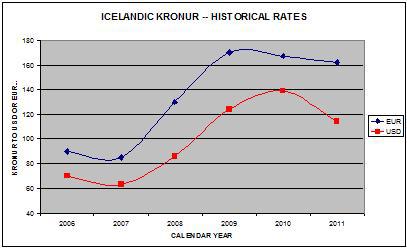
Moreover, it doesn’t look like Iceland will regain its luster any time soon. Its economy has shrunk by 40% over the last two years, and one prominent economist has estimated that it will take 7-10 years for it to fully recover. Unemployment and inflation remain high even though interest rates have been cut to 4.25% – a record low. The Kronur has lost 50% of its value against the Dollar and the Euro, the stock market has been decimated, and the recent decision to not remunerate Dutch and British insurance companies that lost money in Iceland’s crash will only serve to further spook foreign investors. In short, while the Kronur will probably recover some of its value over the next few years (aided by the possibility of joining the Euro), it probably won’t find itself on the radar screens of carry traders anytime soon.
In hindsight, Iceland’s economy was an accident waiting to happen, and the global financial crisis only magnified the problem. With Iceland – as well as a dozen other currencies and securities – investors believed they had found the proverbial free lunch. After all, where else could you earn an 18% by putting money in a savings account? Never mind that inflation was just as high; with the Kronur rising, carry traders felt assured that they would make a tidy profit on any funds deposited in Iceland.
The collapse of the Kronur, however, has shown us that the carry trade is anything but risk-free. In fact, 18% is more than what lenders to Greece and Ireland can expect to earn, which means that it is ultimately a very risky investment. In this case, the 18% that was being paid to depositors were generated by making very risky investments. As the negotiations with the insurance companies have revealed, depositors had nothing protecting them from bank failure, which is ultimately what happened.
Now that the carry trade is making a comeback, it’s probably a good time to take a step back and re-assess the risks of such a strategy. Even if Iceland proves to be an extreme case – since most countries won’t let their banks fail – traders must still acknowledge the possibility of massive currency depreciation. In other words, even if the deposits themselves are guaranteed, there is an ever-present risk that converting that deposit back into one’s home currency will result in losses. That’s especially true for a currency that is as illiquid as the Kronur (so illiquid that it took me a while to even find a reliable quote!), and is susceptible to liquidity crunches and short squeezes.
When you enter into a carry trade, understand that a spike in volatility could wipe out all of your profits in one session. The only way to minimize your risk is to hedge your exposure.

Sunday, April 17, 2011

Where are Exchange Rates Headed? Look at the Data

Where are Exchange Rates Headed? Look at the Data
At this point, it’s cliche to point to the so-called data deluge. While once there was too little data, now there is clearly too much, and that is no less true when it comes to data that is relevant to the forex markets. In theory, all data should be moving in the same direction. Or perhaps another way of expressing that idea would be to say that all data should tell a similar story, only from different angles. In reality, we know that’s not the case, and besides, one can usually engage in the reverse scientific method to find some data to support any hypothesis. If we are serious about finding the truth and not about proving a point, then, the question is: Which data should we be looking at?

I think the quarterly Bank of International Settlements (BIS) report is a good place to start. The report is not only a great-read for data junkies, but also represents a great snapshot of the current financial and economic state of the world. It’s all macro-level data, so there’s no question of topicality. (If anything, one could argue that the scope is too broad, since data is broken down no further than US, UK, EU, and Rest of World). The best part is that all of the raw data has already been organized and packaged, and the output is clearly presented and ready for interpretation.

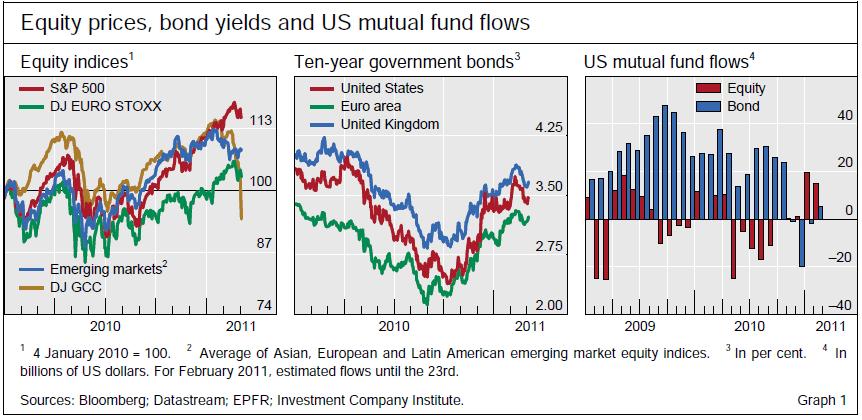
Anyway, the stock market rally that began in 2010 has showed no signs of slowing down in 2011, with the US firmly leading the rest of the world. As is usually the case, this has corresponded with an outflow of cash from bond markets and a steady rise in long-term interest rates. However, emerging market equity and bond returns have started to flag, and as a result, the flow of capital into emerging markets has reversed after a record 2010. Without delving any deeper, the implication is clear: after 2+ years of weakness, developed world economies are now roaring back, while growth in emerging markets might be slowing.
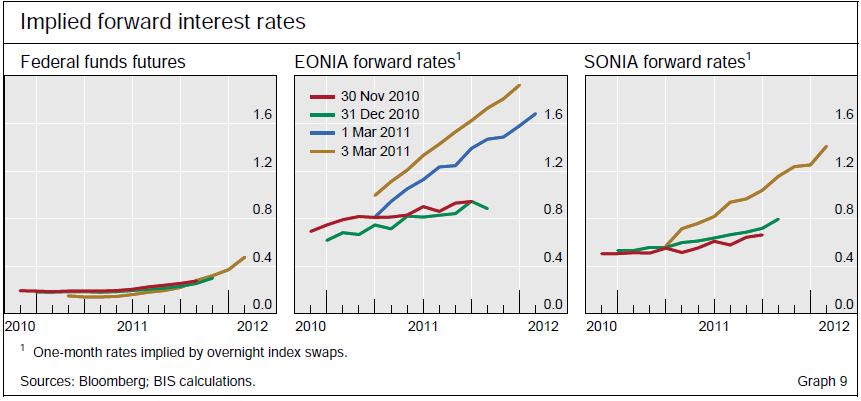
Economic growth, combined with soaring commodities prices, is already producing inflation. (See my previous post for more on this subject). However, the markets expect that the ECB, BoE, and Fed (in that order) will all raise interest rates over the next two years. As a result, while investors expect inflation to rise over the next decade, they believe it will be contained by tighter monetary policy and moderate around 2-3% in industrialized countries.

The picture for emerging market economies is slightly less optimistic, however. If you accept the BIS’s use of China, India, and Brazil as representative of emerging markets as a whole, rising interest rates will help them avoid hyperinflation, but significant price inflation is still to be expected. I wonder then if the pickup in cross-border lending over this quarter won’t slow down due to expectations of diminishing real returns.
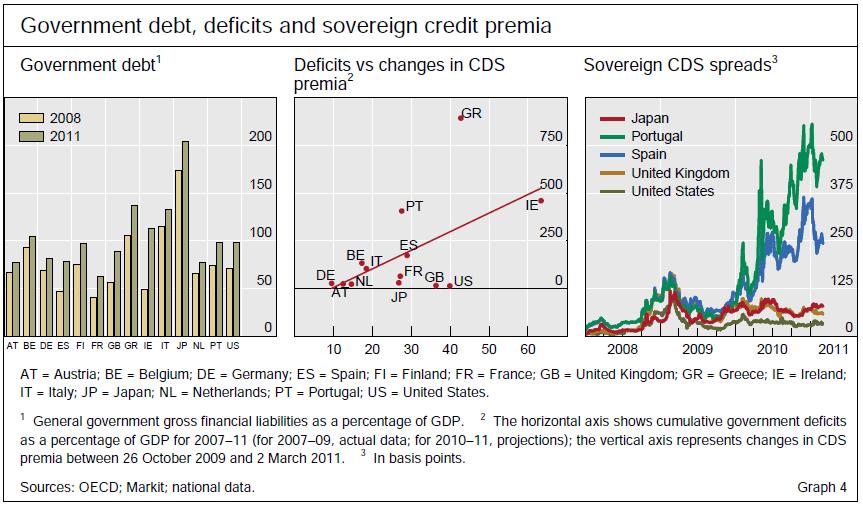
Any sudden optimism in the Dollar and Euro (and the Pound, to a lesser extent) must be tempered, however, by their serious fiscal problems and consequent volatility. As a result of the credit crisis (and pre-existing trends), government debt has risen substantially over the last three years, topping 100% of GDP for the US and 200% of GDP for Japan. Credit default swap rates (which represent the markets’ attempt to gauge the probability of default) have risen across the board. To date, gains have been highest for “fringe” countries, but regression analysis suggests that rates for pillar economies need to rise proportionately to account for the the bigger debt burden. According to a BIS analysis, US and UK banks are very exposed to Eurozone credit risk, which means a default by one of the PIGS would reverberate around the western world.
While I worry that such a basic analysis makes me appear shallow, I stand by this “20,000 foot” approach, with the caveat that it can only be used to make extremely general conclusions. (More specific conclusions naturally demand more specific data analysis!) They are that industrialized currencies (led by the Dollar and perhaps the Euro) might stage a comeback in 2011, due to stronger economic growth and higher interest rates. While GDP growth and interest rates will undoubtedly be higher in emerging markets, investors were extremely aggressive in pricing this in. An adjustment in theoretical models naturally demands a correction in actual emerging market exchange rates!

Sunday, March 27, 2011

Brazil Gets “Real” about Intervention

Brazil Gets “Real” about Intervention
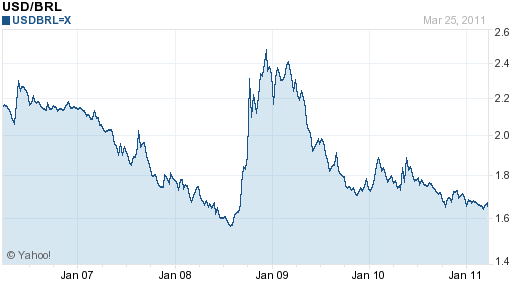
Over the last two years, the Brazilian Real has appreciated a whopping 37% against the US Dollar, second only to the South African Rand. It hasn’t been this strong since prior to the credit crisis, and it is rapidly closing in on a record high. If only Brazilian policymakers hadn’t made it a high priority to prevent that from happening.


The appreciation of the Real is being driven primarily by high interest rates, which in turn, are being driven by inflation. Brazilian prices are now rising at an annualized pace of 6%, which is well above the Bank of Brazil’s comfort zone. As a result, it has already raised rates several times in this cycle, including a 50 basis point hike at the beginning of this month. Its benchmark Selic rate now stands at a stratospheric 11.75%, which is higher than any other currency in the same tier.
Of course, the Bank of Brazil understands the implications of continuing to hike rates. With inflation as high as it is, however, it doesn’t really have much of a choice. Moreover, investors are betting on additional rate hikes, which means even wider interest rate differentials. When you also factor in a surprising lack of volatility surrounding the Real, it will certainly become an even more popular target currency for yield-hungry carry traders.
The government of Brazil, however, is doing everything in its power to repel this kind of speculation, lest it drive up the Real further and threaten the competitiveness of its export sector. In 2010, it tripled the tax rate on foreign investment in fixed income securities, to 6%. It increase scrutiny on local banks that have sought to borrow abroad. The national government has taken to doing more of its borrowing on the international market, and deposited the proceeds directly into its forex reserves, in order to mitigate the impact on the Real. The government is also contemplating punishing short-term investors by establishing a “lock-up” period for foreign capital.
And yet, Brazil finds itself in a quandary. While its trade balance has remained positive, its current account balance is now entrenched in deficit territory. Just like the US, it remaisn dependent on foreign investors to bridge this gap every month. Perennial budget deficits also mean the government can ill afford to alienate lenders. Finally, the government still wishes to attract legitimate foreign direct investment in infrastructure projects and portfolio investment in the stock market.

If Brazil is successful in limiting speculation – which is difficult, but not impossible given its determination – there is a chance that the Brazilian Real will hold steady. After all, Brazil saves less than it needs to invest, and inflation is high enough that there should be some natural downward pressure on the Real. On the other hand, if volatility remains low and speculators continue to find a way around the new capital controls (tempted by 11.75% short-term deposit rates), it will be difficult for the Central Bank to prevent its rise. It can only sit back, continue to hike rates, and pray that speculators soon lose interest.
Personally, I’m betting that the government of Brazil will achieve some measure of success, at least in the short-term. Of all the emerging-market countries engaged in the currency war, it seems to be the most resolute participant after China. At this point, short of fixing the Real to the Dollar, it has shown that it is willing to do whatever it takes to prevent speculators from winning.

Tuesday, March 22, 2011

“Currency Manipulation” Will Continue, Despite G20

Last month, the G20 finally agreed on the specific factors that would be used to determine whether a country was manipulating its currency. Despite being watered-down (by the usual suspects), the so-called “scorecard” is nonetheless extremely substantive. Unfortunately, the resolution will be backed only by “peer pressure,” rather than any kind of real enforcement mechanism, which means that in practice it is basically worthless.
 
While the proximate goal of the resolution is to eliminate exchange rate manipulation, it’s ultimate goal is to minimize the risk of another economic/financial crisis. Towards that end, a country’s “budget deficit levels, the external imbalance and private savings rates” will be closely scrutinized, and will be warned if any of these factors reach levels that are deemed to be unsustainable. The idea is that an early warning system will prevent the global economy from reaching a point of disequilibrium that is so severe that crisis would be impossible to avert.
 
Of course, the problems with this program are manifold. First of all, there are no concrete numbers. For example, it’s not clear how large a country’s national debt or trade deficit has to reach before it receives a phone call and slap on the wrist from the G20. In fact, you could argue that the same imbalances that precipitated the crisis are largely still in place, which means that some countries should have been warned yesterday.
 
Second, there is no meaningful enforcement mechanism. That means that countries that disregard the resolution don’t really have anything to fear, other than the wrath of investors. In other words, if governments and Central Banks know that they can manipulate their exchange rates with impunity, what’s to stop them? Look at Japan: its public debt is the highest in the world. It runs a perennial trade surplus. Its citizens are notorious savers. And yet, when the Yen rose to a record high, which you might expect from such an imbalanced economy, the G7 (in this case) took the unusual step of pushing the Yen down. I’m not saying this wasn’t the right thing to do, but what kind of signal does this send to other rule breakers.
 
While all emerging market countries took an active interest in exchange rates (and seek to exert some control over their currencies), China is certainly Public Enemy #1, and is the clear target of the “currency manipulation” talk. To its credit, the People’s Bank of China (PBOC) has permitted the Chinese Yuan to appreciate 20% against the Dollar (probably 30% when inflation is taken into account) over the last few years. Meanwhile, both internal government statisticians and the IMF expect its current account surplus to narrow to a mere 5% in 2011, as its economy slowly rebalances.
 
In this sense, I think China is a case in point that the best enforcement mechanism isreality. Specifically, China has reached a point where it cannot continue to pursue an economic policy based on exports, without spurring inflation and causing the inefficient allocation of domestic capital (such as in real estate). It must raise interest rates and accept the continued appreciation of the RMB is an unavoidable byproduct.
 
The same goes for other countries that attempt to hold their currencies down. If they can get away with it, then so be it. If not, I can guarantee that it won’t be the G20 that forces them to change.

Monday, March 7, 2011

Emerging Markets (Asia) Bow to Inflationary Pressures: Currency Appreciation will Follow

Emerging Markets (Asia) Bow to Inflationary Pressures: Currency Appreciation will Follow
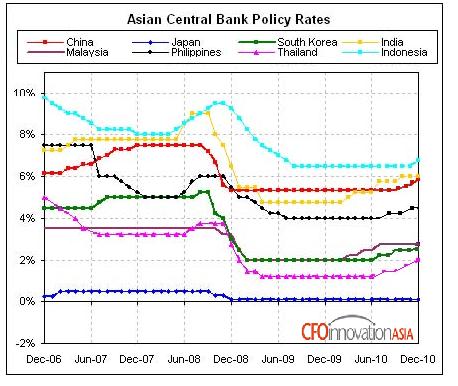
I ended my previous post on the subject by noting that emerging market Central Banks were at a crossroads. Either they would raise interest rates and accept currency appreciation, or they would risk hyperinflation and economic instability. While the jury is still out on a handful of cases, it looks like most of the emerging market countries in Asia have chosen the former.

In February, the Bank of Indonesia raised its benchmark interest rate to 6.75%, from a record low of 6.5%. The People’s Bank of China (PBOC) has now hiked rates three times in the current tightening cycle. After a hike in January, the Bank of Koreainscrutably decided to hold rates in February, but signaled that another rate hike in March is likely. The Central Bank of The Philippines similarly indicated that it is ready to embark on a program of tightening. The same goes for the Reserve Bank of India (RBI). So far the main holdout is the Bank of Thailand, whose interest rates are still the lowest in Asia (ex-Japan) and remains reluctant to raise them too quickly.
Towards the end of January and the beginning of February, most Asian EM currencies sputtered in their appreciation. While there were a number of reasons for this (notably a pickup in risk aversion), Central Banks rejoiced in their perceived victory of foreign currency speculators. Unfortunately, there were a few downsides to this. First of all, capital outflow produced marked declines in Asian stock and bond markets, raising borrowing rates for everyone making it more difficult for domestic firms to raise capital. Meanwhile, inflation continued to rise, with no signs of slowing.
Thus, as I remarked the last time around, it was inevitable that (Asian) Central Banks would inevitably come to their senses. First of all, they realized that there was no free lunch, and that controlling their currencies would disable them from using traditional monetary policy tools to fight inflation. Second, while they could do without currency appreciation, they realized that this would have to be tolerated if they wanted to continue attracting foreign investment. (That’s because, as theFinancial Times pointed out, currency appreciation probably accounts for half of all emerging market investment returns).
Third, it is inevitable that emerging market currencies will continue to rise over the long-term, in line with productivity gains. According to the Balassa-Samuelson effect, “countries with above average real income growth should have rising price levels, relative to other economies, and strengthening real exchange rates.” Based on this notion, emerging market currencies are forecast to rise by an average of 1.7% per year for the next 10 years.
Finally, in accordance with the unofficial rules of the currency war, emerging market countries are competing not with industrialized countries, but with each other. If all of their currencies rise in unison, export competitiveness is unaffected, inflation is tamed, and foreign capital remains abundant. It would seem to be a win/win/win.
In fact, it seems like investors are less interested in distinguishing between the different emerging market currencies of Asia, since at this point, all of them offer similar currency appreciation (over the last six months, returns have converged) and similar inflation-adjusted carry. Thus, it stands to reason that as Asian Central Banks continue to tighten interest rates, their currencies will continue to rise together.